Event Catalog
Browse 117 professional development events

Excel Spreadsheets — Ensuring Data Integrity and 21 CFR Part 11 Compliance
Avoid FDA 483s by properly configuring and validating GxP-compliant Excel spreadsheets — with live step-by-step setup of audit trails, security features, and data entry verification.
 David Nettleton
Cleaning Validation Lifecycle Control: Monitoring Drift, Method Sensitivity, and Revalidation Decisions
This session examines cleaning validation from a lifecycle perspective, focusing on how organizations maintain confidence in validated cleaning processes long after initial approval.
 Meredith Crabtree
EO Sterilization Validation and Revalidation Under ISO 11135: Practical Implementation and Lifecycle Considerations
Learn the ISO 11135 requirements for EO sterilization validation and periodic revalidation — covering equipment IQ/OQ/PQ, overkill approach, sterile load V&V, BIs/PCDs, and lifecycle controls for medical devices.
 John E. Lincoln
Using SPC and Process Data to Support Quality, Stability, and Manufacturing Decisions
Learn how SPC, Six Sigma, and process data support CGMP production controls — sampling plan justification, verification/validation, and trend analysis for non-conformances, complaints, and CAPAs.
John E. LincolnData Integrity: What Exactly Is Required for 21 CFR Part 11, SaaS/Cloud, EU GDPR
Get complete clarity on 21 CFR Part 11, Annex 11, SaaS/Cloud compliance, AI software validation, and EU GDPR requirements for regulated industries.
David Nettleton
Risk-Based CSV/CSA for Modern GxP Systems: Making Defensible Validation Decisions in Practice
A two-day, risk-based framework for CSV/CSA and GAMP® 5 validation decisions on modern GxP systems — cloud, SaaS, configurable, and AI-enabled platforms — built for inspection readiness.
 Carolyn Troiano
Acceptance Criteria for AI Validation: Determining What "Reliable" Actually Means in GxP Systems
Learn how to define meaningful, risk-based acceptance criteria for AI systems in GxP environments — covering reliability thresholds, hallucination controls, human guardrails, and CSA-aligned validation strategies.
Carolyn Troiano
Audit Trail Review by Exception: Reducing Reviewer Burden Without Weakening Detection
Learn how to implement a risk-based audit trail review-by-exception strategy that reduces reviewer fatigue while strengthening detection of critical compliance, data integrity, and cybersecurity risks.
Carolyn Troiano
Digital Quality Metrics and AI/ML Analytics: Building a Continuous-Improvement Framework that Aligns with Regulatory Expectations
Learn how AI/ML and real-time digital quality metrics build a continuous-improvement framework aligned with FDA regulatory expectations, 21 CFR Part 11, and GAMP®5.
Carolyn Troiano
HPLC Analytical Method Development and Validation
Master HPLC instrument and method validation to meet US EPA and FDA requirements for pharmaceutical analysis.
 Dr. John C. Fetzer
Analytical Lifecycle Management Under ICH Q14 and Q2(R2): What Changes Operationally
Understand the operational impact of ICH Q14 and Q2(R2) on analytical method development, validation, transfer, and lifecycle management in regulated pharmaceutical environments.
Meredith CrabtreeUsing EU GMP Annex 22 as the Framework for Governing AI Systems, Validation Traceability, and Data Integrity Controls
Learn how to apply EU GMP Annex 22 as a practical framework for AI system governance, validation traceability, lifecycle management, and data integrity controls in regulated pharmaceutical and biotech environments.
 Charles H. Paul
IQ, OQ & PQ in 2026: What Now Counts as Sufficient Validation Evidence
Understand what constitutes sufficient and defensible IQ, OQ, PQ, and PPQ validation evidence in modern GMP environments — with real-world examples.
Meredith Crabtree
AI in GMP: What the FDA Is Already Expecting - Before You Ask
FDA already expects GMP compliance for AI systems. Learn how existing validation, data integrity, and oversight rules apply—before regulators come calling.
 Dr. Ginette Collazo
The First FDA Warning Letter on AI: What It Means for Your Quality System
The FDA issued its first AI-related Warning Letter. Learn what it means for your QMS, validation requirements, and how to keep your quality systems inspection-ready.
Dr. Ginette CollazoAI Errors May Be Impossible to Eliminate — What That Means for Its Use in the FDA
AI errors may be statistically unavoidable. Learn how to build controls, oversight, and governance models that make AI safe, compliant, and inspection-ready in FDA-regulated environments.
Dr. Ginette CollazoChange Control for SaaS and AI Systems: Managing Configuration Drift and Revalidation Without Creating Validation Backlogs
Risk-Based CSV/CSA for Modern GxP Systems: Making Defensible Validation Decisions in Practice
A two-day, risk-based framework for CSV/CSA and GAMP® 5 validation decisions on modern GxP systems — cloud, SaaS, configurable, and AI-enabled platforms — built for inspection readiness.
Carolyn TroianoUsing SPC and Process Data to Support Quality, Stability, and Manufacturing Decisions
Learn how SPC, Six Sigma, and process data support CGMP production controls — sampling plan justification, verification/validation, and trend analysis for non-conformances, complaints, and CAPAs.
John E. LincolnIQ, OQ, PQ in the Verification and Validation Process
Develop a Master Validation Plan and defensible IQ, OQ, PQ protocols aligned with FDA cGMP, ICH Q9, ISO 13485, and ISO 14971 risk management standards.
John E. LincolnPart 11, Data Integrity & Documentation for SaaS/PaaS Validation — 3-Hour Course
A 3-hour deep dive into 21 CFR Part 11 and data integrity for SaaS/PaaS cloud systems — covering audit trails, shared responsibility, change management, and FDA inspection readiness.
Carolyn TroianoHow to Validate Automated Pipelines Under CSA — 3-Hour Course
A 3-hour course on validating CI/CD pipelines and automated workflows under CSA — challenge-based testing, automated evidence, and maintaining audit readiness in rapid-release environments.
Carolyn TroianoThe CSA Playbook for SaaS, PaaS & Modern Digital Platforms — 3-Hour Course
A 3-hour CSA playbook for SaaS and PaaS validation — learn to evaluate vendor evidence, interpret SOC reports, separate responsibility, and build FDA-defensible documentation.
Carolyn TroianoThe Smart Way to Classify Cloud GxP Systems Before You Validate — 3-Hour Course
A 3-hour course on classifying cloud GxP systems with precision using CSA — assess intended use, GxP relevance, risk, and shared responsibility before validation begins.
Carolyn TroianoCSA in Practice: How to Build Defensible Evidence the FDA Actually Wants to See
Break through CSV conditioning — learn how to build FDA-defensible evidence using CSA, size effort with risk-based thinking, and align with GAMP 5 (2nd Edition) without the paperwork burden.
Carolyn TroianoExcel Spreadsheets — Ensuring Data Integrity and 21 CFR Part 11 Compliance
Avoid FDA 483s by properly configuring GxP-compliant Excel spreadsheets — step-by-step setup of audit trails, security features, Part 11 compliance, and minimal-documentation validation.
David NettletonFDA's 21 CFR Part 11 Add-On Inspections
Navigate FDA's increased scrutiny of electronic records and software validation — implement effective 21 CFR Part 11 V&V strategies aligned with GAMP, ISO 14971, and real-world inspection expectations.
John E. LincolnAnalytical Method Validation under Good Laboratory Practices (GLPs)
Master analytical method validation under GLP — covering statistical requirements, selectivity, stability assessment, reagent comparison, and FDA compliance for pharmaceutical laboratories.
Dr. John C. FetzerProject Management Best Practices for Computer Systems Regulated by FDA
Apply project management best practices to FDA-regulated computer system implementations — covering SDLC, CSV, GAMP V, roles, documentation, and maintaining systems in a validated state.
Carolyn TroianoLeveraging AI in Risk Assessment for Smarter Computer Systems Validation
Apply AI responsibly to CSV risk assessment — build defensible, inspection-ready risk models that align with CSA, GAMP 5, and FDA data integrity expectations.
Carolyn Troiano
Contamination Prevention and Environmental Control
Build inspection-ready contamination control systems — cover cleanroom behavior, environmental monitoring, sanitation validation, and GMP expectations under 21 CFR 211.
Charles H. PaulProcess Validation Requirements and Compliance Strategies
Recalibrate your process validation program — connect IQ/OQ/PQ to FDA and ISO frameworks and build robust, reliable processes that withstand regulatory scrutiny.
 José Mora
Risk-Based Excel Spreadsheet Validation
Apply SDLC, GAMP 5, and risk-based validation to Excel spreadsheets used in FDA-regulated activities — covering Part 11, data integrity, and inspection preparation.
Carolyn TroianoDigital Quality Metrics and AI/ML Analytics: Building a Continuous-Improvement Framework that Aligns with Regulatory Expectations
Learn how AI/ML and real-time digital quality metrics build a continuous-improvement framework aligned with FDA regulatory expectations, 21 CFR Part 11, and GAMP®5.
Carolyn TroianoRecording available
AI in GMP: What the FDA Is Already Expecting - Before You Ask
FDA already expects GMP compliance for AI systems. Learn how existing validation, data integrity, and oversight rules apply—before regulators come calling.
Dr. Ginette CollazoRecording available
HPLC Analytical Method Development and Validation
Master HPLC instrument and method validation to meet US EPA and FDA requirements for pharmaceutical analysis.
Dr. John C. FetzerRecording available
IQ, OQ & PQ in 2026: What Now Counts as Sufficient Validation Evidence
Understand what constitutes sufficient and defensible IQ, OQ, PQ, and PPQ validation evidence in modern GMP environments — with real-world examples.
Meredith CrabtreeRecording available
Data Integrity: What Exactly Is Required for 21 CFR Part 11, SaaS/Cloud, EU GDPR
Get complete clarity on 21 CFR Part 11, Annex 11, SaaS/Cloud compliance, AI software validation, and EU GDPR requirements for regulated industries.
David NettletonRecording available
AI Errors May Be Impossible to Eliminate — What That Means for Its Use in the FDA
AI errors may be statistically unavoidable. Learn how to build controls, oversight, and governance models that make AI safe, compliant, and inspection-ready in FDA-regulated environments.
Dr. Ginette CollazoRecording available
The First FDA Warning Letter on AI: What It Means for Your Quality System
The FDA issued its first AI-related Warning Letter. Learn what it means for your QMS, validation requirements, and how to keep your quality systems inspection-ready.
Dr. Ginette CollazoRecording available
FDA Warning Letters & Computerized Systems: From Validation Failures to Inspection-Ready CSV/CSA
Learn what FDA warning letters reveal about software validation, data integrity, audit trails, Part 11, CSV, CSA, change control and inspection readiness.
Meredith Crabtree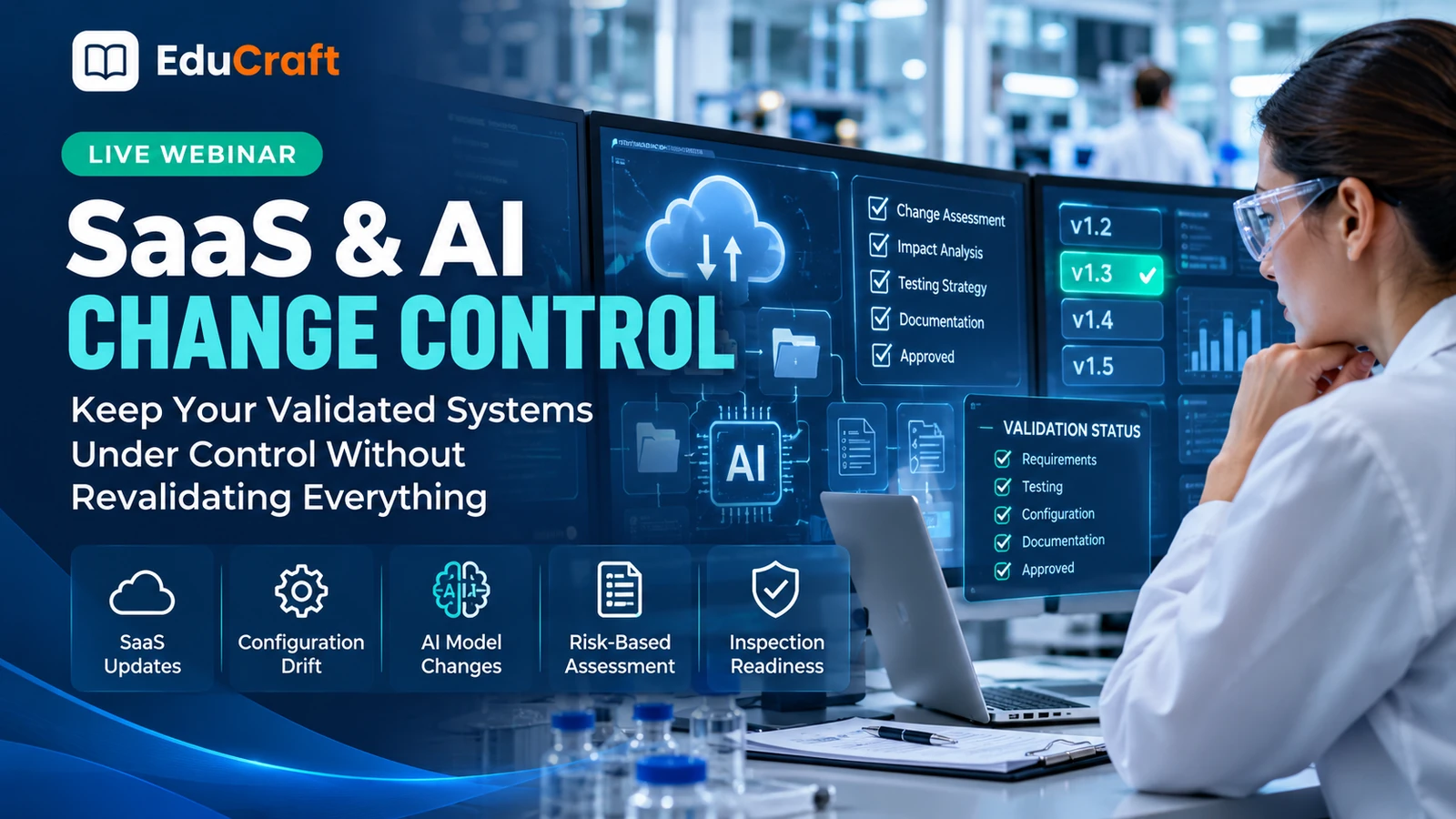
SaaS & AI Change Control: Keep Your Validated Systems Under Control Without Revalidating Everything
Learn how to manage SaaS updates, configuration drift, vendor releases and AI model changes using risk-based change control—without turning every update into a full revalidation project.
Carolyn TroianoSoftware Validation Observations in FDA Warning Letters and Consent Decrees: Patterns, Root Causes, and Remediation Expectations
Analytical Lifecycle Management Under ICH Q14 and Q2(R2): What Changes Operationally
Understand the operational impact of ICH Q14 and Q2(R2) on analytical method development, validation, transfer, and lifecycle management in regulated pharmaceutical environments.
Meredith CrabtreeRecording available

Risk-based Excel Spreadsheet Validation - 2026 Updates
Master risk-based Excel spreadsheet validation for FDA-regulated environments — covering GAMP 5, SDLC, 21 CFR Part 11, data integrity, and inspection readiness.
Carolyn TroianoRecording available
Acceptance Criteria for AI Validation: Determining What "Reliable" Actually Means in GxP Systems
Learn how to define meaningful, risk-based acceptance criteria for AI systems in GxP environments — covering reliability thresholds, hallucination controls, human guardrails, and CSA-aligned validation strategies.
Carolyn TroianoRecording available
Audit Trail Review by Exception: Reducing Reviewer Burden Without Weakening Detection
Learn how to implement a risk-based audit trail review-by-exception strategy that reduces reviewer fatigue while strengthening detection of critical compliance, data integrity, and cybersecurity risks.
Carolyn TroianoRecording available
Using EU GMP Annex 22 as the Framework for Governing AI Systems, Validation Traceability, and Data Integrity Controls
Learn how to apply EU GMP Annex 22 as a practical framework for AI system governance, validation traceability, lifecycle management, and data integrity controls in regulated pharmaceutical and biotech environments.
Charles H. PaulRecording available
EO Sterilization Validation and Revalidation Under ISO 11135: Practical Implementation and Lifecycle Considerations
Learn the ISO 11135 requirements for EO sterilization validation and periodic revalidation — covering equipment IQ/OQ/PQ, overkill approach, sterile load V&V, BIs/PCDs, and lifecycle controls for medical devices.
John E. LincolnRecording available